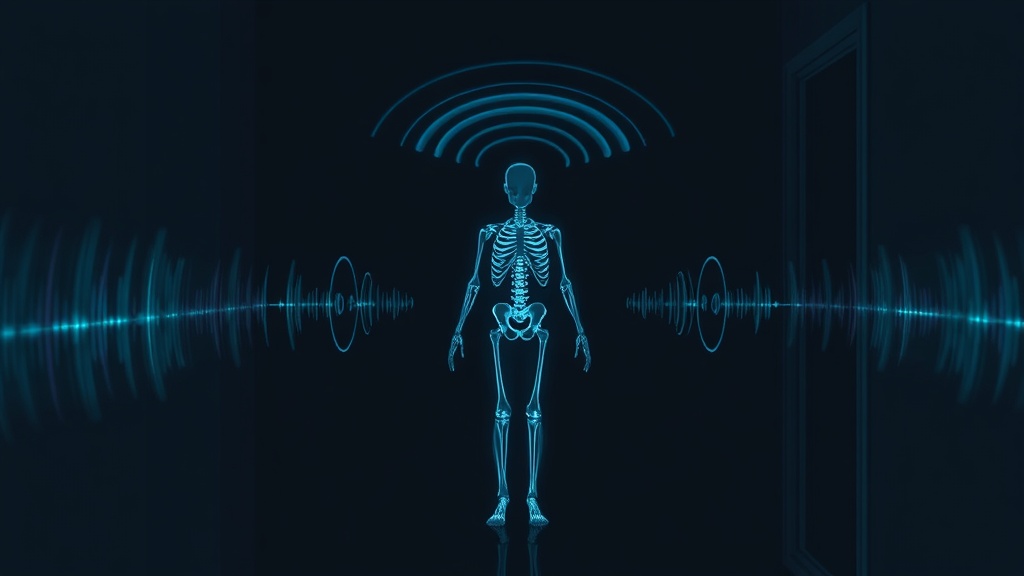
Every wireless signal you broadcast bounces off your body, your walls, your furniture — and returns changed. For decades, that reflected data was noise to be filtered out. What if it’s actually the most powerful proximity sensor you’ve never deployed?
I’ve spent 33 years building wireless networks. From the first metro WiFi in Tucson to GPS-synchronized mesh for defense applications. And one of the most striking research threads I’ve encountered recently doesn’t come from a defense lab or a Silicon Valley unicorn. It comes from the physics of the air around you.
WiFi Channel State Information (CSI) — the raw signal data your router already collects — can detect human presence, estimate body position to 17 skeletal keypoints, and measure breathing rate and heartbeat. Through walls. In total darkness. With no camera required.
The project is called RuView. And it changes how I think about what a mesh network actually is.
What WiFi Sensing Actually Does (The Physics)
When a WiFi signal travels from your router to a device, it doesn’t take a straight path. It reflects off walls, furniture, people — and each reflection creates a measurable change in the Channel State Information that the receiving device reports back. This is the same multipath propagation that traditional WiFi treats as interference to suppress.
WiFi sensing flips the model. Instead of suppressing multipath, it analyzes it. The changes in CSI magnitude and phase across multiple subcarriers encode spatial information about everything the signal touched on its way through the room.
RuView’s implementation uses ESP32-S3 nodes (the same chip architecture as our Tessera mesh nodes) to capture CSI at up to 54,000 frames per second, processed through a Rust pipeline that delivers presence detection in under 1 millisecond. The pose estimation runs at 30 fps with sub-meter accuracy.
Detection range: through 30cm reinforced concrete. Through multiple walls. In complete darkness. In environments where cameras are either illegal, impractical, or simply wrong for the use case.
Why “No Camera” Is the Strategic Moat, Not a Limitation
Every computer vision company in the defense and safety space is building camera-dependent systems. Surveillance cameras, body cameras, drone cameras. The AI is getting better. The cameras are getting cheaper. And the regulatory, legal, and ethical walls around camera-based surveillance are getting higher.
There are entire categories of high-value deployment environments where cameras simply cannot go:
- Medical facilities — patient privacy regulations make camera-based monitoring legally complex in treatment areas
- Senior care — dignity concerns around continuous video surveillance in private spaces
- Critical infrastructure — buildings where personnel movement tracking via video creates insider threat documentation risk
- Commercial buildings post-GDPR/CCPA — occupancy and flow analytics without biometric data collection
- Contested environments — where cameras can be physically blocked, destroyed, or turned
WiFi sensing produces no images. No video. No biometric data. It detects presence, position, and movement — the three things that actually matter for safety and security applications — without capturing any data that could constitute surveillance under any current or proposed privacy regulation.
That’s not a workaround. That’s a structural advantage that camera-based systems can never replicate.
The Edge Orbital Integration Path
Here’s where it gets interesting from a systems architecture perspective.
ESP32-S3 — the chip powering RuView’s sensing nodes — is the same family as the hardware running Tessera mesh nodes. The dual-purpose firmware path is a straight line: deploy a mesh node, add CSI capture mode, and the network infrastructure you built for communications becomes a sensor array.
The integration roadmap has three natural phases:
Phase 1 — Server-side inference: Deploy RuView on Edgestor (our RTX 5060 edge server). WiFi CSI data streams from ESP32 nodes to the server via the existing mesh. Inference runs centrally. Latency is sub-10ms at typical mesh distances. Zero compute burden on the nodes themselves.
Phase 2 — Dual-mode node firmware: Tessera nodes that also run CSI capture. The same hardware that forwards mesh packets also samples the RF environment. Every node becomes a presence sensor. Network density equals sensing density.
Phase 3 — iPhone RSSI sensing: Coarser resolution but zero additional hardware. iPhone WiFi RSSI variance correlates with human presence with surprising accuracy. Use Tripwire Recon’s sensor pipeline — already capturing BLE, GPS, barometric, and motion data — to add environmental awareness from WiFi signal patterns the phone already receives.
What This Means for the Spatial Intelligence Platform
I’ve been describing Edge Orbital as building “wireless infrastructure that perceives.” WiFi sensing is the mechanism that makes that phrase technically precise rather than metaphorical.
The Tessera mesh — GPS-synchronized TDMA protocol, zero protocol-layer collisions, 5-10x throughput over ALOHA methods — creates the communications backbone. That backbone can simultaneously collect the environmental data that turns a network into a spatial intelligence platform.
No competitor is doing this. The mesh networking companies are focused on connectivity. The computer vision companies are focused on cameras. The sensor fusion companies are focused on wearables. Edge Orbital sits at the intersection of all three — with patent-pending technology on the mesh protocol layer and a clear integration path for sensing capabilities that require no cameras, no biometrics, and no privacy exposure.
This is not a feature. It’s the moat.
The dataset that accumulates from a deployed mesh that also senses — presence patterns, occupancy flows, threat signatures — is an asset that compounds over time. Every deployed node adds signal. Every additional deployment makes the dataset richer. And the dataset is the defensible value, not just the hardware.
“The connectivity is the business model. The spatial intelligence is the moat. The dataset is the asset.”
If you’re building in defense, critical infrastructure, or safety — and you’re trying to figure out how sensing integrates with communications at the edge — I’m happy to talk through the architecture. The pre-seed round is open. The technology is live.
By Christopher Wolff — Founder, Edge Orbital. 33-year wireless veteran. Published patent application inventor.
Stay Inside the Network
Defense tech, spatial intelligence, and mesh networking, from the edge to orbit. Get technical deep dives, deployment updates, and early access to the sensing stack.