If you’ve been following location-based gaming, you’ve probably noticed something odd: Niantic, the company that created Ingress and Pokémon GO — two of the most successful GPS games in history — seems to be moving away from gaming.
Layoffs. Corporate restructuring. A $3.5 billion acquisition by an AR hardware company. The launch of “Niantic Spatial” as a platform play rather than a consumer product.
What happened? Did Niantic abandon gaming? Are they pivoting? Or was this always the plan?
The answer is simpler than it looks: The games were never the product. The spatial data was.
Which Niantic games went to Scopely, and what stayed with Niantic Spatial? This is the clean 2026 split people are searching for after the sale.
October 2026 update: the former Niantic games team is now called Scopely Explore (same team behind Pokemon GO, Pikmin Bloom, and Monster Hunter Now – new name and logo, same games). Only the branding changed. If you searched “what happened to Niantic,” this rename is the latest answer: Niantic Spatial kept the spatial-tech platform and Ingress, while Scopely Explore runs the games.
| Portfolio | Games in 2026 | Status |
|---|---|---|
| Scopely | Pokémon GO, Pikmin Bloom, Monster Hunter Now | Live under new ownership |
| Niantic Spatial | Ingress, Peridot | Still held after the split |
| Shut down | Harry Potter: Wizards Unite | Sunset before the portfolio split |
If you searched for the Niantic games list in 2026, this ownership table is the short answer, and it explains why the company now looks so different in both search and the market.
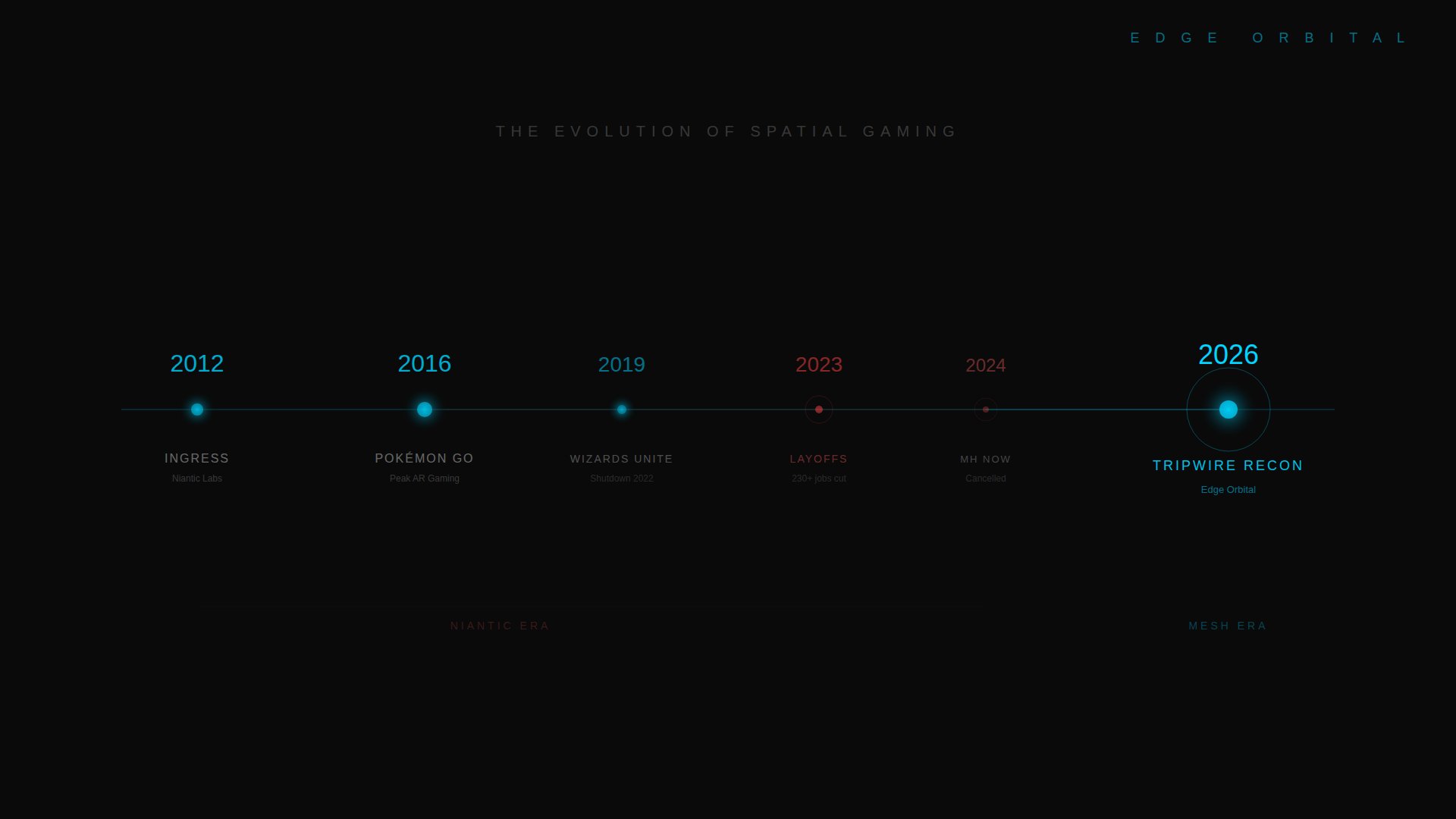
The Timeline: From Ingress to Acquisition
2012: Ingress Launches
Niantic spun out of Google as an internal startup with a mission: prove that location-based gaming could work. Ingress was the experiment — a faction warfare game built on real-world landmarks.
It worked. Over 20 million people downloaded Ingress. But more importantly, those players generated something unprecedented: crowdsourced spatial data on a global scale.
Every portal submission was a human verifying: “This landmark exists here.” Every link and field was proof that a player physically traversed that path. Every gameplay session was training data for real-world movement patterns.
2016: Pokémon GO Explodes
When Pokémon GO launched, it became a cultural phenomenon literally overnight. Within weeks, it had more active users than Twitter. Players were walking into traffic, trespassing, and gathering in parks by the thousands.
The game was built on Ingress’s infrastructure — the portal database became PokéStops and Gyms. But the IP (Pokémon) and the casual gameplay loop made it accessible to hundreds of millions of people who would never have played Ingress.
Once again, those players weren’t just having fun. They were generating data. Movement patterns. Location interactions. Real-world AR anchor validation.
2018-2023: More Games, Same Goal
Niantic launched:
- Harry Potter: Wizards Unite (2019, shut down 2022)
- Pikmin Bloom (2021, still running)
- Monster Hunter Now (2023, Capcom partnership)
- Peridot (2023, AR pet game)
Some succeeded. Some didn’t. But all of them collected spatial data. All of them trained users to interact with AR content in the real world.
2025: The $3.5B Acquisition
In March 2025, Scopely acquired Niantic’s gaming division for $3.5 billion — bringing Pokémon GO, Monster Hunter Now, and Pikmin Bloom under new ownership. The deal was one of the largest private M&A transactions in mobile gaming history.
But Niantic didn’t disappear. The real story is what happened next.
2025-2026: Niantic Spatial Spins Off
Concurrent with the Scopely deal, Niantic spun off its geospatial AI business into a new standalone entity: Niantic Spatial Inc., led by founder John Hanke with $250 million in capital. Ingress and Peridot were restructured under Niantic Spatial.
The message was clear: the games were valuable, but the spatial intelligence platform was the long-term bet. Niantic Spatial focuses on VPS access, AR infrastructure, and spatial computing tools for enterprise and smart city applications.
The Real Asset Was Never the Games
Here’s what Niantic understood earlier than almost anyone: spatial intelligence is the foundation of the next computing platform.
What Is Spatial Intelligence?
Spatial intelligence = understanding the 3D geometry, features, and context of the real world at scale.
Think of it as a “3D map,” but instead of just roads and buildings, it includes:
- Visual landmarks and how they look from every angle
- How people move through spaces
- Where AR content can be anchored reliably
- Environmental context (lighting, weather, occlusions)
This data is critical for:
- Autonomous vehicles (understanding context beyond GPS)
- AR glasses (anchoring virtual content to real-world surfaces)
- Robotics (navigating human environments)
- Smart cities (optimizing traffic, infrastructure, services)
- Enterprise logistics (indoor navigation, delivery optimization)
Why Gaming Was the Perfect Collection Mechanism
Niantic could have paid surveyors to map the world. Instead, they made it fun and got millions of people to do it for free:
- Players verified landmarks (Ingress portals, PokéStops)
- Players confirmed pathways (Where can humans actually walk?)
- Players tested AR anchors (Does this virtual object stay stable when viewed from different angles?)
- Players generated context (What time of day is this park busiest?)
Every Pokémon caught, every portal hacked, every AR photo taken was training data for spatial computing systems.
Niantic didn’t pivot from gaming to spatial computing. Gaming was always the spatial computing play.
Why Spatial Computing Matters
If you’re not deep in tech, “spatial computing” might sound like buzzword soup. But it’s the next major platform shift — as significant as the move from desktop to mobile.
The Platform Layers
1980s-2000s: Desktop Computing Your computer was a box on a desk. The interface was a screen and keyboard.
2007-2025: Mobile Computing Your computer became a phone in your pocket. The interface was a touchscreen.
2025-2040: Spatial Computing Your computer becomes your environment. The interface is the world itself.
Why You Need Spatial Intelligence for This
For AR glasses, autonomous vehicles, or smart city systems to work, they need to understand:
- Where am I, precisely? (GPS is only accurate to ~5 meters)
- What am I looking at?
- How does this space change over time?
- Where can I safely place virtual objects or navigate?
That’s spatial intelligence. And Niantic has one of the largest spatial datasets on the planet — crowdsourced, verified, and continuously updated by millions of players.
The Market Gap Niantic Left Behind
Here’s the irony: Niantic’s shift to B2B enterprise creates a vacuum in consumer-facing location gaming.
They proved the market exists. Hundreds of millions of people love location-based gameplay. But as Niantic focuses on selling VPS to enterprise clients, who fills the gap?
Who’s Building the Next Generation?
Pokémon GO will continue (it still makes massive revenue), but as a legacy product. Don’t expect radical innovation.
Smaller studios are emerging with games built on modern infrastructure:
- Mesh-verified presence (solving the spoofing problem)
- LoRa and edge networks (off-grid gameplay)
- Modern mobile development (better UX, battery optimization)
- Independent studios with gaming as the core mission, not a data collection side effect
Independent spatial technology companies are entering the space — companies like Edge Orbital building spatial intelligence platforms with gaming as one application among many (smart cities, mesh networking, IoT).
The next generation of location gaming won’t be dominated by one company. It’ll be distributed across specialized players solving specific problems.
What Spatial Intelligence Means for Smart Cities and Enterprise
Niantic’s pivot to enterprise makes sense when you look at the infrastructure applications:
Smart Cities
- Traffic optimization based on real movement patterns
- Infrastructure planning informed by actual pedestrian behavior
- AR wayfinding for tourists and residents
- Emergency response routing
Enterprise
- Indoor navigation for warehouses and campuses
- AR maintenance and training overlays
- Delivery routing optimization
- Autonomous vehicle navigation context
The same technology that made Pokémon GO fun makes smart cities efficient and enterprise logistics smarter.
Niantic figured this out. Others are following.
Edge Orbital’s Approach: Gaming Meets Spatial Intelligence
Full disclosure: this article is published by Edge Orbital, a spatial computing company building the Tessera mesh network and Tripwire Recon, a location-based faction warfare game.
We’re not hiding that. We’re following a similar playbook to Niantic — but with a key difference:
We’re building the gaming and infrastructure applications in parallel, not sequentially.
- Tripwire Recon = consumer-facing location game (spiritual successor to Ingress)
- Tessera = LoRa mesh network providing spatial intelligence for enterprise, smart cities, and IoT
- Integrated from day one = the game generates data that strengthens the network; the network makes the game more secure and resilient
CJ Wolff, Edge Orbital’s founder, spent 33+ years in telecom infrastructure (including building the world’s first metro WiFi in 1998). He understands that the network infrastructure and the consumer application need to evolve together.
Niantic proved the model. We’re building on it.
Niantic Didn’t Fail. They Succeeded.
Let’s be clear: Niantic’s journey from Ingress to a $3.5B acquisition to Niantic Spatial isn’t a failure or a “pivot away from their roots.”
It’s the plan coming to fruition.
They proved location gaming could work. They built the world’s largest crowdsourced spatial dataset. They monetized it at B2B scale.
The fact that players feel nostalgic for the Ingress golden age or wonder why Pokémon GO innovation has slowed doesn’t change this: Niantic achieved exactly what they set out to do.
But it does create opportunity for the next generation of developers to carry the torch — building location-based games not as data collection mechanisms, but as games first, with spatial intelligence as a valuable side effect.
What Comes Next?
Spatial computing is here. AR glasses are improving. Mesh networks are scaling. Autonomous systems are deploying.
The question isn’t whether spatial intelligence will matter. It’s who builds the infrastructure and who gets to use it.
Niantic opened the door. Now it’s a race to see who walks through it.
Want to Be Part of What’s Next?
Tripwire Recon is out now on iPhone — a faction-warfare location game built on mesh-verified presence and the Tessera spatial intelligence network.
If you’re interested in where location gaming meets spatial computing, join our newsletter.
Related Reading
- For Ingress Players: The Spiritual Successor
- Why Mesh Networks Change Location Gaming
- Why Ingress Players Are Looking for Alternatives in 2026
- Tessera: The Spatial Intelligence Fabric
The baton has been passed — and the technology that makes location gaming work outdoors is the same infrastructure powering the human mesh safety network. Explore Tripwire Recon and see how the human mesh works for safety programs. Try Tripwire Recon free on the App Store.
The baton has been passed. The race continues.
Want this story made operational? See Tripwire Recon Play and group radar for people who move together — and try Tripwire Recon free on the App Store.