Every location-based game ever made — from Ingress to Pokémon GO to Geocaching — shares the same fundamental architecture:
- Your phone’s GPS determines where you are
- Your phone tells the game server those coordinates
- The server trusts you and updates the game state accordingly
This model has enabled amazing gameplay experiences. It’s also fundamentally broken.
Because here’s the problem: GPS coordinates are trivially easy to fake.
And for over a decade, location gaming has been locked in an arms race between spoofers and anti-cheat systems that can never truly win. Detection improves. Spoofing tools get smarter. Accounts get banned. New accounts appear. The cycle continues.
But there’s a better way. One that makes spoofing not just hard, but mathematically impossible.
Mesh-verified presence is the future of location gaming. Here’s why.
The Current Model: Why GPS + Cellular Can’t Solve Spoofing
Let’s understand the problem before we discuss the solution.
How Current Location Games Work
When you play Pokémon GO, Ingress, or any GPS-based game:
- Your phone’s GPS chip receives signals from satellites and calculates your position
- Your game app sends those coordinates to the game’s cloud servers (usually over cellular or WiFi)
- The server checks: “Okay, user claims to be at latitude X, longitude Y”
- The server updates the game state: spawns Pokémon, unlocks portals, credits you for being there
The Spoofing Problem
The server has no way to verify you’re actually there. It only knows what your phone claims.
So spoofers use:
- Mock location apps (Android makes this trivially easy)
- Modified game clients (altered APKs that send fake coordinates)
- GPS emulators (software that simulates satellite signals)
- Hardware spoofing (rare but possible with SDR equipment)
Why Detection Doesn’t Solve It
Game companies try to detect spoofing by analyzing:
- Movement patterns (did you just teleport 500 miles?)
- Device sensors (is your accelerometer moving but GPS staying still?)
- IP geolocation (do your coordinates match your network location?)
- Behavioral analysis (are you playing 24/7 without fatigue?)
But all of these are heuristics — educated guesses. Sophisticated spoofers know how to avoid detection:
- Simulate realistic walking speeds
- Use VPNs matching their spoofed location
- Mimic human play patterns
- Rotate accounts to avoid behavioral flags
The result? Casual spoofers get caught. Sophisticated spoofers dominate competitive play. The game becomes “who has the better spoofing setup” rather than “who has the better strategy.”
This Kills Competitive Gaming
Ask any competitive Ingress or Pokémon GO player what their #1 frustration is. It’s not bugs. It’s not balance. It’s knowing the person you’re competing against might not even be there.
When you can’t trust that opponents are actually walking the same streets you are, the entire premise of location-based gaming collapses.
What If the Network Was the Game?
Here’s a different model:
Instead of your phone telling a distant server where you are, what if the physical infrastructure around you verified your presence?
That’s mesh networking.
Mesh Networks: A Simple Primer
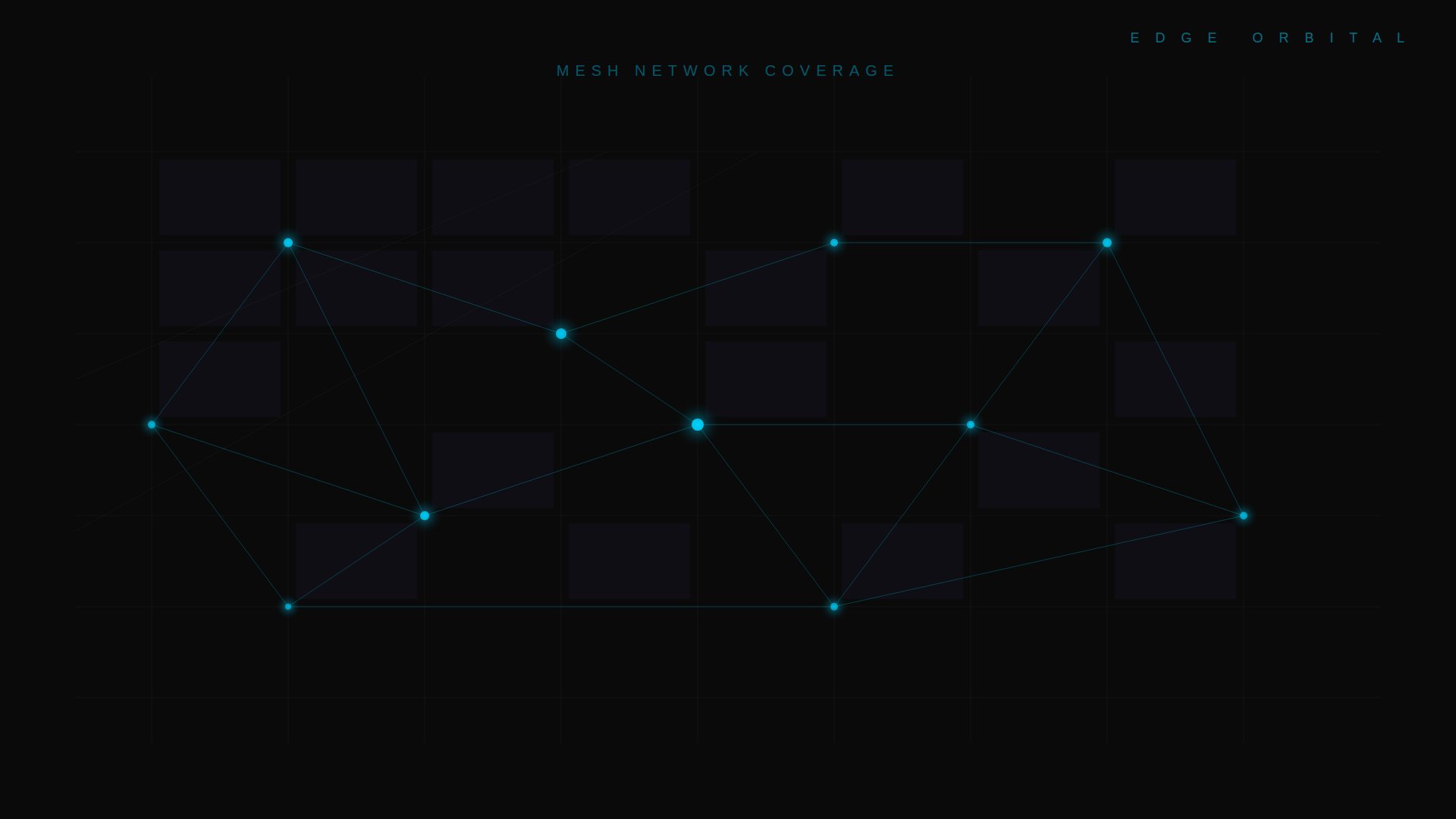
A mesh network is a decentralized network where devices (nodes) communicate directly with each other rather than routing everything through a central server.
Think of it like this:
- Traditional network: Everyone talks through the cell tower (hub-and-spoke)
- Mesh network: Devices talk to nearby devices, which relay messages across the network (web)
Mesh networks have been used for decades in:
- Emergency communications (resilient, hard to disrupt)
- IoT sensor grids (low power, wide coverage)
- Emergency response (works when cellular fails)
- Rural connectivity (community-owned infrastructure)
LoRa: The Technology Enabling Mesh Gaming
LoRa (Long Range) is a wireless protocol designed for low-power, long-range communication. A single LoRa node can reach 10+ miles in open terrain, 1-3 miles in urban areas.
LoRa mesh networks are:
- Low power (nodes run on batteries for years)
- Long range (miles, not feet)
- License-free spectrum (915 MHz in US, no FCC license needed)
- Resilient (if one node fails, the mesh routes around it)
This makes LoRa perfect for creating physical infrastructure that games can run on top of.
Mesh-Verified Presence: How It Solves Spoofing
Here’s how a mesh-based location game works:
Step 1: Physical Nodes Exist in the Real World
LoRa mesh nodes are deployed at strategic locations (rooftops, utility poles, businesses that host them). Each node has GPS, knows its exact position, and can communicate with nearby nodes and players.
Step 2: Your Phone Communicates With Nearby Nodes
When you’re in range of a mesh node (up to a mile or more), your phone communicates directly with it via LoRa. The node cryptographically verifies your device is actually communicating with it, not spoofing the interaction.
Step 3: The Mesh Network Validates Your Presence
Multiple nodes can confirm your position through signal strength, timing analysis, and triangulation. The network itself attests: “Yes, this device is physically here.”
Step 4: The Game State Updates Based on Mesh Verification
Only actions verified by the mesh network count. You can’t claim to be at a location unless the physical infrastructure confirms it.
Why You Can’t Spoof This
To spoof mesh-verified presence, you would need to:
- Physically intercept LoRa signals from actual nodes
- Convincingly mimic cryptographic handshakes in real-time
- Defeat triangulation from multiple nodes
- Do this while not actually being within radio range
This isn’t “hard.” It’s impractical to the point of impossibility for 99.9% of would-be spoofers.
And for the 0.1% with the technical skill? They’d need to be physically near the nodes anyway — which defeats the purpose of spoofing.
What Mesh-Verified Gaming Enables
Solving the spoofing problem unlocks gameplay that was never truly viable before:
Truly Competitive Territory Control
When you know opponents are physically there, defending territory becomes meaningful. You’re not just fighting GPS coordinates — you’re contesting actual space.
Off-Grid Gameplay
LoRa mesh works without cellular coverage. You can continue operations in areas with poor cell service, during network outages, or in remote locations where traditional connectivity fails.
The Network Becomes the Terrain
Physical mesh nodes become strategic points on the map. Controlling areas with dense node coverage gives advantages. Deploying your own nodes becomes part of the metagame.
Fair Competition
Everyone plays by the same rules. The player who wins is the one with better strategy, better coordination, better execution — not better spoofing tools.
Tripwire Recon: The First Mesh-Verified Location Game
Tripwire Recon is Edge Orbital’s location-based faction warfare game built on the Tessera LoRa mesh network.
It’s designed from the ground up around mesh-verified presence:
- Your location is confirmed by the network itself
- Strategic points are tied to actual mesh nodes
- Spoofing is impossible
- Gameplay continues even off-grid
We’re not retrofitting mesh verification onto a GPS game. We built the game and the network together.
The Tessera Network
Tessera is Edge Orbital’s LoRa mesh infrastructure. It’s:
- Multi-purpose — supports gaming, but also smart city, IoT, and enterprise applications
- Community-deployable — Anyone can host a node and expand the network
- Cryptographically secure — Enterprise-grade verification protocols
- Based on two provisional patents — GPS-PPS TDMA synchronization and crowdsourced spatial intelligence
The Game
- Four factions: Vieux Carré Spectres, Crescent City Corsairs, Bayou Shadows, Iron Balcony Order
- Territory warfare: Capture, defend, contest
- AI operatives: The game fights back
- New Orleans setting: Because we’re building the initial network here first
- Live on iPhone
Get Tripwire Recon on the App Store →
The Dual-Use Future: Gaming Meets Critical Infrastructure
Here’s where it gets interesting:
The same mesh network that makes fair competitive gaming possible also enables:
- Smart city sensor grids
- Emergency communications when cellular fails
- Supply chain and logistics tracking
- IoT connectivity in underserved areas
- Decentralized spatial intelligence
Gaming isn’t just a fun use case. It’s a data generation and network resilience mechanism.
Players deploying nodes, moving through the network, and verifying locations aren’t just playing — they’re strengthening community infrastructure.
This is the Niantic model (games as spatial data collection), but with the infrastructure as a first-class product, not just a side effect.
This Is Just the Beginning
Mesh-verified presence doesn’t just solve the spoofing problem. It fundamentally changes what’s possible in location-based gaming:
- Persistent territory that can’t be captured remotely
- Off-grid operations in areas without cellular
- Cryptographically provable player achievements
- Integration with physical infrastructure as a game layer
We’re at the beginning of a shift as significant as the move from PC gaming to mobile gaming.
The network is becoming the game. The game is becoming the network.
And the players who were there from the start? The network will remember.
Play Tripwire Recon
Tripwire Recon is out now on iPhone. Get it free on the App Store →
If you want to see how this sensor and network logic crosses into the real world, explore the personal safety platform. If you want the wedge-plus-moat version of the business, start at /invest.
Related Reading
- For Ingress Players: See how Tripwire Recon compares
- Why Ingress players are looking for alternatives in 2026
- What happened to Niantic? From Pokémon GO to spatial computing
- Best location-based games in 2026
The future of location gaming isn’t in the cloud. It’s in the mesh.