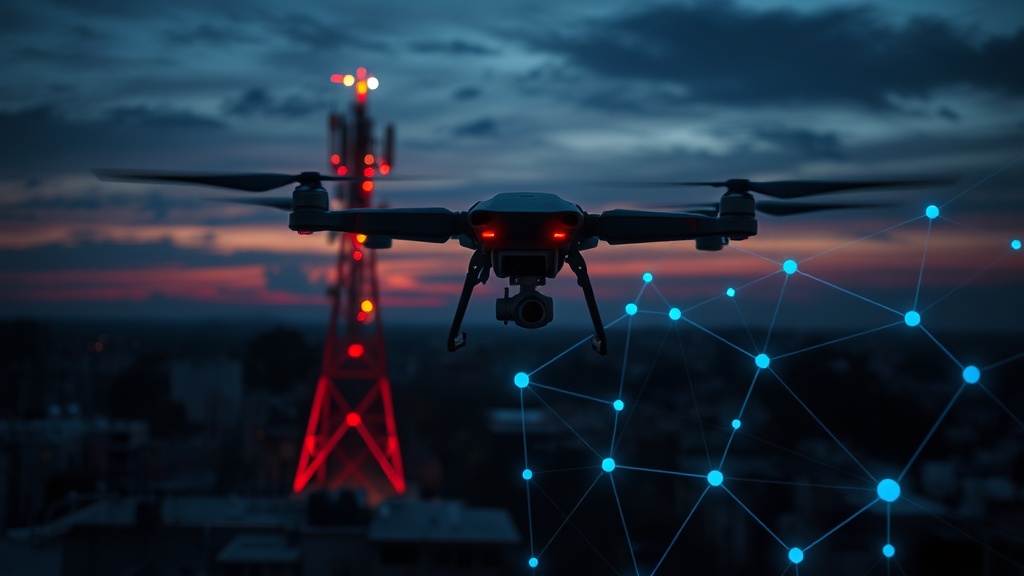
Ukraine’s combat drones are running on civilian 4G/5G networks. A new Enea report confirms what battlefield operators already know: relying on public cellular networks for military operations is a vulnerability, not a feature.
This isn’t just a Ukraine problem. It’s the future of every contested environment where tactical communications depend on infrastructure that adversaries can target, jam, or destroy.
The Problem: Military Drones on Public Cellular Infrastructure
Ukraine’s combat drone operations have demonstrated something remarkable — and deeply concerning. Military UAS platforms are increasingly relying on civilian 4G and 5G networks for command and control, telemetry, and real-time video feeds. It works — until the adversary decides it shouldn’t.
Electronic warfare units on both sides of the conflict are actively targeting cellular base stations and deploying wideband jammers that render commercial spectrum unusable. The moment an adversary jams, degrades, or simply destroys cellular infrastructure, every drone depending on that tower goes deaf.
This is the fundamental flaw of building tactical communications on consumer infrastructure: you’re depending on someone else’s tower staying up in a warzone.
Why Public Cellular Fails in Contested Environments
Cellular networks — whether 4G LTE or 5G NR — were designed for consumers, not for electronic warfare environments. They assume three things that don’t hold in combat:
- Fixed infrastructure. Cell towers that stay standing and powered. In contested environments, towers are targets.
- Cooperative spectrum. No adversary is actively trying to deny access to the RF environment. In modern warfare, spectrum is contested by default.
- Centralized coordination. A core network managing every connection, handling handoffs, and maintaining session state. Destroy the core, and every endpoint is orphaned.
The dependency on centralized infrastructure is the single point of failure that sophisticated adversaries will exploit — and the Enea report confirms they already are.
The Alternative: GPS-Synchronized TDMA Mesh Networking
The resilient path isn’t better cellular. It’s purpose-built mesh networking with GPS-synchronized TDMA (Time Division Multiple Access) at the MAC layer — what we’re building with Tessera Mesh at Edge Orbital.
Here’s what makes this approach fundamentally different from both cellular networks and existing mesh protocols like Meshtastic’s ALOHA-based channel access:
No Infrastructure Required
Every node in a Tessera Mesh network is a peer. There are no towers, no base stations, and no core network to target. The network exists wherever the nodes are — and moves with them. This is the architecture that tactical communications demand: infrastructure-independent, mobile, and resilient.
Deterministic Spectrum Access via GPS PPS
GPS Pulse Per Second (PPS) synchronization gives every node in the mesh a precise, coordinated time reference. This enables true TDMA — each node transmits only during its assigned time slot. The result: zero protocol-layer collisions, deterministic latency, and predictable throughput regardless of network density.
Compare this to ALOHA-based mesh protocols where nodes transmit randomly and hope they don’t collide. At 50+ nodes pushing position location information (PLI) updates, random backoff destroys your refresh rate. TDMA maintains discipline at scale.
Consumer Hardware, Military Protocol Discipline
Tessera Mesh runs on sub-GHz LoRa radios at 915 MHz — affordable, commercially available hardware operating in ISM bands that don’t require spectrum licenses. The innovation isn’t the radio — it’s the patent-pending protocol layer that brings GPS-synchronized TDMA to consumer mesh hardware for the first time.
Two provisional patents have been filed. Hardware prototyping is underway on Heltec T114 platforms running Zephyr RTOS.
Scales Without Degradation
Traditional mesh protocols degrade exponentially as you add nodes — more nodes means more collisions, more retransmissions, and lower effective throughput. GPS-synchronized TDMA maintains zero protocol-layer collisions regardless of how many nodes join the network. The superframe structure accommodates growth without sacrificing performance.
From Ukraine’s Lessons to Tomorrow’s Tactical Architecture
The Enea report confirms what mesh networking engineers have been saying: the future of tactical communications cannot depend on infrastructure that an adversary can deny. Combat drones, ground sensors, dismounted personnel, autonomous vehicles, and collaborative combat aircraft all need a communications layer that works when everything else is being jammed.
The constellation is the clock. The protocol is what makes it useful.
GPS-synchronized TDMA on mesh radios isn’t a concept — it’s being built right now. And the lessons from Ukraine are proving exactly why it’s needed.
Follow the Build
Edge Orbital, Inc. is building Tessera Mesh — a GPS PPS-synchronized TDMA protocol for consumer LoRa mesh radios that delivers deterministic spectrum access without centralized infrastructure.
We’re raising a $3M pre-seed round to bring this from prototype to production. If you’re working in defense communications, mesh networking, tactical autonomy, or spectrum management:
- Join the mailing list — follow the build from firmware to field
- Learn about the raise — $3M SAFE at $12M cap
- Connect on LinkedIn — Christopher Wolff, Founder & CEO
Christopher Wolff is a published patent inventor and the founder of Edge Orbital, Inc. He previously built the world’s first metropolitan WiFi networks in Downtown Tucson, AZ. The views expressed here are solely those of the author and do not represent the views of any employer, past or present.